Click on photos to enlarge, please do not copy photos without permission

Thursday, 9 February 2012

Patch additions and surveying

As of late I am in a semi-retired state, I am getting more time to visit the patch and am also very lucky in that I get to go to different locations to survey for birds; such has been the case over this week.
When I say patch, like many other Londoners I take part in a light hearted competition every year to see how many species you can record on your local patch or flying over it, all my mates do it as well. It is good clean fun, the rewards are far more satisfying if you find a local rarity yourself, each year you try and beat the previous year’s total.
This week I have visited both Barking Bay and Barking Outfall, both are turning up good birds due to the weather, the way it looks with the freeze continuing it is likely that even more wildfowl and waders are going to grace the Thames.
I visited Barking Bay on Wednesday and covered as much ground as I could, of Stonechat there is still no sign, I can remember seeing up to 8 birds here, the recent hard winters have hit them hard unfortunately.
After covering most of the site I got 3 additions to the patch watching the river, this held good numbers of waders as the tide was out.
A female Sparrowhawk absconding to Kent joined the list as did a small flock of 8 Wigeon drifting down on the tide, they are not usually here and quite hard to get.
The best of the lot was an adult Mediterranean Gull resting up on the mud, I managed a couple of digi shots of this, although they are getting more regular every winter, locating one amongst the hundreds of Black Headed Gulls is another matter.

Heavily cropped photos of the Mediterranean Gull


Grey Plover at roost
The mud flats produced a good count of waders in 121 Redshank, 300 Dunlin, 9 Grey Plover, 9 Curlew, 112 Black Tailed Godwits, 5 Snipe and a single Ringed Plover.


Surveying

From Barking Bay I headed for Dagenham Riverside for the monthly hide tide count along the foreshore and the jetties. The main jetty on its day holds very large numbers of waders, namely Black Tailed Godwit, Lapwing and Redshank, today was no different.
Black Tailed Godwit numbered 454 with a single Bar Tailed mixed in with them; the supporting cast was 4 Curlew, 63 Shelduck, 84 Teal, 53 Redshank, 26 Gadwall and 29 Lapwing.
All of these jetties/structures are vitally important for London’s waders and wildfowl, steps are now in the process of trying to safeguard them all.

Black Tailed Godwit piling into the roost


Still room for more
Thursday found me near Coryton surveying a large area which I have to admit I really enjoy, it has regularly turned up some good birds, despite the conditions, a white blanket of snow all over, I still saw some good birds.
I also came across a hunting male Sparrowhawk going after a small bird in a small bush; it looked like a Pipit, despite the Pipits advantage inside the bush, the Sparrowhawk would not give up even though it was getting hooked up. At one point one wing was caught and he could not move, in the end he reversed and came in at a different angle from the outside, the scrambled pursuit inside the bush continued and then suddenly the Pipit made a break for it.It unfortunately was his undoing as the Sparrowhawk caught him after a brief chase, the Pipit was probably exhausted. Sad yes, but nature is nature, everything has to eat.

Male Sparrowhawk


I also had a male Marsh Harrier come over, too far away for photos but always good to see a striking adult male.
There seems to be an influx of Woodcock everywhere at the moment and it was one bird that I thought I might pick up, this proved true with one bird seen, a bit distant and bad light but identifiable.


A heavily cropped Woodcock


Tuesday, 7 February 2012

Barking Outfall and Beckton


With the recent weather I headed down to the Outfall as I knew that, as in past winters, the wildfowl increases dramatically with the arrival of hard weather. Looking over the sea wall confirmed this with Tufted Duck hugging the low tide shoreline all stretched out, a later count recorded 362 birds, a good start to the morning.
Wildfowl numbers had gone through the roof, a count produced 102 Gadwall and 167 Shoveler, Teal I could only estimate, certainly 500+.With a rising tide Cormorants were piling in as well, a count of 52 came up but this was increasing all the time, on mid river there was also 8 Great Crested Grebes.
I turned my attention to the mud flats at the Outfall and looking west; this produced 6 Black Tailed Godwits, 146 Redshank, 2 Curlew and 2 rare waders for the Outfall, a single Bar Tailed Godwit and 3 Grey Plovers. The Bar Tailed Godwit I was particularly pleased with as it was unexpected; the Grey Plover I thought was likely given Gary’s and Nick’s sightings the other day. Having said that it is only the 2nd time I have recorded Grey Plover at the Outfall.


Grey Plover

Grey Plover showing the black armpits

Lapwing and Common Snipe

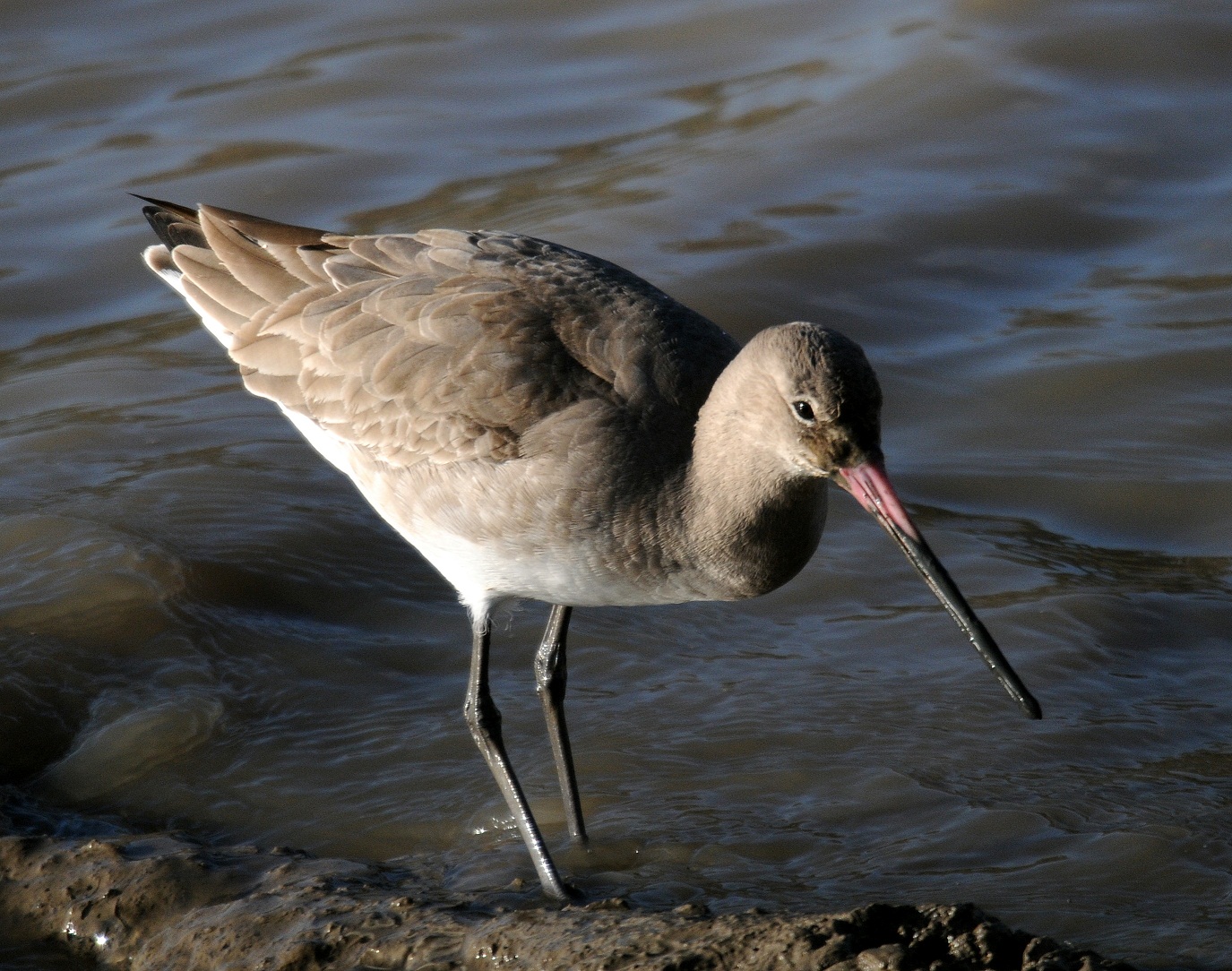
Black Tailed Godwit


With Beckton slightly upriver I headed around there where the 2 East India men had done so well, I was lucky and arrived just as the tide was rising, it pushed birds towards me.
Scanning through the rocks on the water line showed 9 Common Snipe at the edge, just as I got on another one it flushed with the others due to a cyclist coming through, even before it flushed I had seen enough to confirm Jack Snipe. I had all to brief views as it went east with the Commons, the difference in size is quite apparent; it was seen to drop in around the corner.


Meadow Pipit

Common Snipe

Grey Plover

Other waders present were 3 more Grey Plover, I know just like Buses, these were a separate 3 as I had seen presumably the same 3 seen earlier fly upriver. Also a good sized flock of 38 Lapwing were floating around and eventually landed briefly before heading off down river.
All in all a very good morning, I would like to have stayed longer to see what else turned up.

Ringing Return

I recently posted photos of a colour ringed Sanderling taken at Southend on Sea on February 4th, courtesy of Steve Arlow, Simon Buckle and Jeroen Reneerkens in Greenland, I now have the information on the bird.Thanks go to them for such a quick response, see below.


 Colourcode:  B3YRYR           Name Ringer:  Antoine Dervaux             2nd Ringer:  Johannes Lang

  Ringnumber:                           8224096          Date Catch: 2-7-2011          Catching Place:       Karupelv valley, Trail island

                                                                                                        Greenland          72.29.58 N 23.59.05 W

  Sightings of this bird:

  Date(d/m/y)  Place                                             Observer                 2nd Observer            3rd Observer

   4-2-2012    Southend on Sea, Essex                          David Morrison

                  United Kingdom   51.32.05 N 00.41.29 E


Saturday, 4 February 2012

Kittiwakes - Southend Pier


I started the morning a little undecided as to where to go, I am not use to having many spare weekends, there usually tied up with either Surveying, Peregrines or out with my missus. In the end I plumbed for Canvey Point arriving just after 7.30am, after 45 minutes with the usual birds seen I started to think about the Pier. Knowing that the 1st train out is 9.15am, I went, in all honesty I was numb from the cold and wanted to thaw out in the car.Arrived at the pier ,train delayed until 10.00am to check for ice, so eventually got out there at 10.10am.
High tide was around 9.40am, even as I walked up the pier I started to see Kittiwakes sitting around the pier on the sea and at least half a dozen mixed in with the Med’s on the ramp.


Oystercatcher


As many will know, the ramp where the Purple Sandpiper roosts and the Med Gulls rest is now unapproachable, you can’t get anywhere near it, this is due to all the construction works taking place and the fencing to keep you out.
Of the Purple Sandpiper there was no sign, work was taking place above and below so most likely disturbed, even the ‘tame’ Turnstones were not on the ramp. Going to the upper level I took a count of Kittiwakes resting up on the river, I ended up with 67, there were more further out at a distance.
Of the 2 ships I saw coming in both had large numbers of Kittiwakes following so it was quite obvious there was quite a number of birds in the Estuary. I stayed for just under 2 hours, surprisingly no Red Throated Divers or Auks were seen despite the cold conditions, highlights were 3 Pintail and 3 Great Crested Grebes. I spent most of the morning getting photos of the Kittiwakes, good to see them present in 1st winter and adult stage, as with the Mediterranean Gulls, most stages were present.

 
Ist winter Kittiwake

Adult


Ist winter


Prior to coming on to the pier I killed a bit of time on the foreshore where I had a small flock of Sanderling and a similar flock of Dark Bellied Brent Geese. In amongst the Sanderling flock was a colour ringed or flagged bird, will send it through, be good to see where it originated.

Juvenile Dark Bellied Brent Goose

With adult

Colour ringed Sanderling

Also amongst the Brent Geese was a juvenile, this is the first one I have seen here at Southend.


Thursday, 2 February 2012

Barking Bay February 2nd


Cold, it was bloody freezing at dawn with – 3 showing in the car, the tide was just starting to drop with some mud already showing.
I checked the Snipe area first, as expected all frozen up but none the less 9 birds flushed which I watched very closely hoping for a Jack. With the promise of even colder weather on Friday and the weekend it is likely more Snipe will make an appearance along with more waders and waterfowl.


Frozen Snipe Pools
Moving on I checked the Graffiti area for any goodies but was very surprised to find a chap sleeping rough in what looked like a quilt, he must have been freezing but he was sound asleep. I know Paul saw him the other day and it gave him a bit of a shock, see his blog. With the sub-zero temperatures it does go through your head, is he all right, to make sure I started shouting at him, ‘are you ok mate?’ On the 5th shout he responded, ‘yes I am ok’, he didn’t sound old, I asked him again to make sure and he said yes no worries. He didn’t come out from the cover, it makes you wonder the story behind how he got there, quite sad really, hopefully he will be ok, I notified Barking Riverside just in case.
Back to the birding, walking inland produced 25 Fieldfare and a large flock of Lapwing numbering around 120 birds, a lot higher than the usual fare so possibly cold weather movement, they usually roost on the jetty. Additional to this a Green Woodpecker was seen along with 4 Skylarks, still no Stonechat.


Skylark

Lapwing at roost on site

Lapwing

Linnet


By now hands and feet were dropping off so I began to walk back, a final scope around as there was now more mud showing produced a single Curlew, Grey Plover, 67 Redshank, 83 Shelduck, 35 Black Tailed Godwits and 5 Ringed Plover on the Jetty.
The Linnet flock was hovering around 120.


Ringed Plover roosting on the main jetty


Monday, 30 January 2012

North Kent Marshes


Sunday dawned, survey time again over the other side of the water, also another chance to have a crack at the Rough Legged Buzzard.
Driving down with Paul and the temperature gauge in the car showed 1 above, worse still was the dense foggy conditions which had blanketed just about everywhere. On arrival visibility was down to 100 metres as we started the survey, I looked round and the only thing that shone through all the gloom was Paul’s high forehead, it was like a beacon shining through.
Not much chance of finding many birds in this stuff, but surprisingly we did, Paul recorded Bearded Tit again along with Cetti’s Warbler which I also recorded, and Common Buzzard was seen by both of us.
When it did eventually clear, around 11.00am, we were both on the river at our respective watch points; the numbers of waders over the Kent side is quite staggering. The mud flats here are far larger than on the Essex side, consequently far more birds, for starters I had 3100 Dunlin stretched out in front of me, Paul had a similar count of Dunlin at the other end.Wigeon peaked at 860 with 700 odd Dark Bellied Brent’s seen to the east of us. Between us we also had nearly 300 Curlew and 200 Grey Plover, it makes you realise how important these Thames mud flats are, unbelievably some pratt called Boris wants to stick an airport near here.

Stonechat


When we had finished we looked for the Rough Legged Buzzard, eventually picking it up after coming across Marsh Harrier, 2 Common Buzzards and male and female Merlin, all were distant but good views were had of most.

Very distant Rough Legged Buzzard


The Rough Leg eventually flew towards us and we got better views through the scopes, again distant but it was very wary and liked to keep a ¼ mile buffer zone between it and us. It is a cracking looking bird and the challenge in the coming months, if it stays whilst we survey, will be to get a decent photo of it. With the promise of cold weather coming it is unlikely to move on if it has a food source, and could hopefully be joined by another. With up to 3 Common Buzzards on site food does not seem to be a problem.

Short Eared Owl


We also caught up with the regular Short Eared Owl, out hunting in the gloomy weather at 2.00pm, a fine end to the day watching it tangling with a Kestrel. Photos are poor owing to the naff weather and the bird’s not playing ball.


Saturday, 28 January 2012

Bickering Black Tails


There is a site on the Essex side of the Thames where, if everything is right, I can get some half decent photos of mainly Black Tailed Godwits. I found this site a few years back by accident whilst surveying, it is an old concrete jetty facing west, half collapsed and disused. When high tide rises in this area, the mud directly in front is the last showing.The trick with it is to get to it without being seen by all and sundry, mainly Black Tailed Godwit, Teal and occasional Redshank. The SAS would have been proud of the approach, every blade of grass is used for cover to reach it.
Once inside, it is a welly job as the mud is quite deep here and there, there are a series of small holes where a telephoto lens can be placed without spooking the birds, it is the perfect hide.
Everything has to come together on the day, I have to catch the tide right as it is rising, it has to be sunny, and most of all the Black Tailed Godwits have to feed on this last bit of mud instead of going to roost.
It doesn’t always happen, on Friday it did.


Click on photos to enlarge


Anyone who has ever seen Black Tailed Godwit together will know what I mean when I say bickering, they don’t stop, feathers are constantly raised and fights quite frequent, presumably amongst the males.