Click on photos to enlarge, please do not copy photos without permission

Tuesday, 12 November 2013

Drake Teal


Photos below were taken at Beckton Sewage Works on Sunday, good to see some sunshine at last.


Backlit Curlew


Saturday, 9 November 2013

Rainham RSPB


November 9th


Although rain was forecast mid morning, the morning looked good when I arrived at 7.00am, it became apparent straight away that huge numbers of Wood Pigeons were moving south. The temperature had dropped also with only 4 degrees showing in the car, the temperature drop had also bought with it more waders and wildfowl.

Curlew in the early morning gloom

The foreshore along the Thames was teeming and before I entered the Reserve I had recorded, 110 Golden Plover, 2 Curlew, 119 Black Tailed Godwits, 62 Redshank, 67 Dunlin and 14 Ringed Plover. Also present were 9 Rock Pipits and 3 Common Seals were hauled out on the Kent side.
The time now was 8.00am and as I walked into the Reserve I totted up the counts of Wood Pigeons and for that hour period recorded 8050, I should imagine just the tip of the iceberg, all seemed to be crossing very high east by the QE2 bridge.

Arriving at the Target Pools showed it now holding a lot of water and consequently a lot of Wildfowl, it was heaving and I tracked down the recent Barnacle Goose in with some Canada’s, no doubt dodgy credentials. Having said that if it comes over to the Valley with Greylags it’s going straight down on the year list…..


Definitely wild....

A quartering male Marsh Harrier was also seen, seem to be getting as common as Peregrines now over the Reserve, a welcome sight to see and must certainly be the most reliable site in London to see one. It’s got to the point now when I walk round that I expect to see one, as I write this I see that Rainham has had 4 today.

Pressing on I came to the northern boardwalk, I always look for Penduline’s when I get here, it’s been a few years now since the last visit, one morning ………

5 Pintail were on the Pools and Lapwing were everywhere, again there were many more waterfowl, oddly though I didn’t see one Little Egret.


I could see the bad weather rolling in so I made a bee line for the centre, birds of note in the woodland were 2 Fieldfares, as yet there doesn’t seem that many Redwings around either, I suspect the constant westerly’s have a lot to do with it.


Monday, 4 November 2013

RSPB Bowers Marsh


First impressions – November 4th


Lured by the prospect of seeing the 4 Spoonbills, most definitely the same 4 birds I saw on October 24th at Coalhouse Fort and a Glossy Ibis, I made my first visit to the new reserve,not ideal weather at the start but it soon cleared to reveal a sunny day, if a little windy.
To get to the reserve you have to go to Pitsea, drive past Lidl’s and then take Church Lane further up on your right, stay on this road and it takes you right to the Reserve.

A good start as I pulled up in the car park as I recorded 14 Corn Buntings dotted around with just as many Pied Wagtails, presumably a wagtail roost nearby, perhaps Pitsea Town. Had a look at the signboard to get my bearings, hides were present so I was hopeful of some photos, this turned out to be a bit of false dawn as I couldn’t locate one hide, certainly not the ones marked.


Back lit Corn Bunting

The map - hides marked but not present - likely for the future

Nether less it looked a great place and I can see it becoming a firm favourite as through the morning, I stayed there from 9.00am to 12.30pm, it produced some good birds, even though I didn’t catch up with the Spoonbills and the Glossy.

For the first hour I was there on my own, walking round to the Freshwater Lagoon produced a male Marsh Harrier, 2 calling Water Rail and 2 Bearded Tits, Cetti’s Warbler were also very evident. As I moved on 3 Black Tailed Godwit, 2 Green Sandpipers (flushed by female Sparrowhawk) and a Curlew joined the list along with another Marsh Harrier, this time a female.


Wigeon and Teal are seemingly everywhere and constantly flushing due to the Marsh Harriers that were quartering, at one point I was treated to the whole lagoon erupting as a Tiercel Peregrine came in. He latched onto 4 Pochard but was unsuccessful as the ducks lost height and went back onto the Lagoon at a rate of knots, smart ducks.


Peregrine after the 4 Pochard

As I walked on I had a pair of Stonechat on the fence line and then came across a Swallow sitting on the fence, only the 2nd one I have had in November, testament to the relatively mild weather?
It was very healthy as it hawked for insects a number of times, with a northerly I was surprised it was still here.


Moving on I came to the end of the Freshwater Lagoon and it was here that I came across a flock of 9 Bearded Tits, all looking very lively in the sunshine and contact pinging as they flew over the reedbed.Like a lot of elusive birds just don’t get to see these little crackers enough.


You can do a circular walk but I opted to backtrack the way I had come, nothing to add other than a flyover Rock/Water Pipit calling, couldn’t get enough on it to confirm id.

All in all a very good visit made all the better by good weather, it has the makings of a great reserve and I can see it being a regular site for me, hopefully the Spoonbills and the Glossy Ibis will make another appearance.


Sunday, 3 November 2013

Garden


Returning home from Rainham Marshes this morning, which by the way was pretty quiet owing to the strong wind, I had an hour or so this afternoon photographing in the garden.
From the window I had 2 Jays and a Green Woodpecker working the lawn, quite amusingly the Jays were watching a Grey Squirrel burying acorns and then doing there level best to find them.
Highlights from Rainham were 2 Curlew, 4 Rock Pipits and 7 Pintail. The Great Tit below was taken at Rainham.


Friday, 1 November 2013

High Tide Roosts


Moving forward!


Following on from my post of September 24th - it has been a bit of a slog but thanks to the London Wildlife Trust (Mathew Frith), Environment Agency and with help from the PLA it has now progressed further with the Thames Estuary Partnership now becoming involved.

On October 11th I attended a meeting in London with a number of others and came away content that it is now moving forward and gathering pace. Obviously I am just bird minded but there is, as always a far bigger picture, it seems as if the whole project can possibly be tied up with related fish conservation on particular roosts/structures.

It is an exciting project and I realise it’s not going to happen overnight, I am by nature impatient but realised from the meeting that the number of organizations/companies/people involved and the permissions needed to take this further is going to take time. Approaching individual owners of structures/jetties will be the next step in 2014 and there is also the possibility of funding for us, the ITHTG.
The main thing is that it is moving forward with the help of a lot of people who like me can see the value to wildlife of all these roosts.

Below shows one of the maps produced by GIGL, this is the roosts at Galleon’s Reach, it is one of 15 maps. The Jetty in Spring/Summer also houses the largest colony of breeding Lesser Black Backed and Herring Gulls in London as far as I am aware.


The Inner Thames as we know is a working river and is also the most densely populated urban area in Europe, consequently the pressure on the river ecologically is immense. Brownfield sites are fast disappearing also, areas of land that once supported breeding Lapwing, Shelduck and even Redshank are going. My local patch Barking Bay is being developed for housing and I have no doubt that one day West Thurrock Marshes will go. The marshes would have made a great reserve complimenting Rainham RSPB, with some landscaping it could have been something special due to the numbers of winter waders it attracts on its mud flats.

I could never understand why the RSPB never campaigned for it but that’s another story.

Wednesday, 30 October 2013

Cormorant City


In 2012 I went to Bulgaria with Bradders, Jono and Dick, it is and still is one of the best, if not the best birding country I have been to including Spain. Admittedly I haven’t travelled all round Europe birding other countries but I have birded Spain a fair few times, Spain is very good but in my opinion not up there with Bulgaria. It is hard to imagine anywhere else reaching the density of the birds that we saw and the specialist species; I have heard good things about Poland and Hungary but am yet to go there.
The long and short of it is that I would like to go back and do the other half, the mountainous region , having said that, would be just as happy to go back to the same itinery and places as 2012, it was that good. In 2012 we more or less stayed on the Black Sea coast ranging from Burgas right up to near the Romanian border with occasional sorties inland for specialist species.


Poda Reserve - a nest box for all

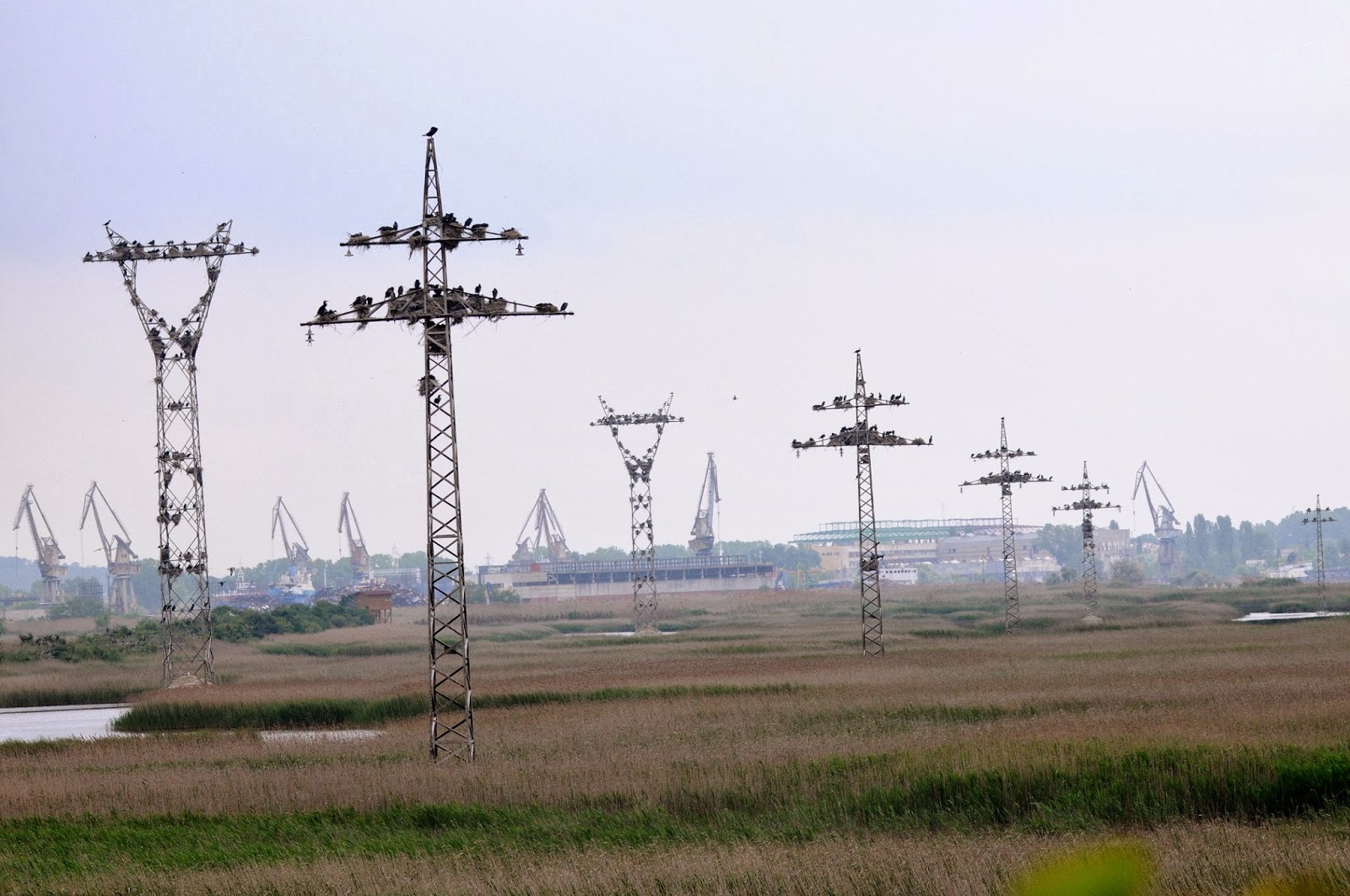
One place that did stick in my head was the Poda Reserve, set in an industrial background south of Burgas and right next to a major highway, it was an unusual place and not you’re every day bird reserve. If I remember correctly we had both Great White and Dalmatian Pelicans here along with Pygmy Cormorants but what it is also well known for is its colonies of Great Cormorants. These have taken over a number of used and disused pylons and used every square inch to colonise and breed on, it is a spectacular sight.


Cormorants as far as the eye can see


Monday, 28 October 2013

Black Redstart


Got lucky over the weekend with this full adult male Black Redstart looking good in the sunshine and posing nicely.