Click on photos to enlarge, please do not copy photos without permission

Thursday, 12 July 2018

Valley Spoonbill


Along with Great White Egret, added as long ago as July 17th 2006, can’t believe it’s been that long, Spoonbill has been up there as a hoped for patch tick since time began for the Valley.

These days Great White Egret is still a rarity but becoming more likely, however the 2006 bird still remains my only record for the Valley.

The Spoonbill is only the 2nd site record, a big well done to Dave McGouth for finding it on Tuesday and putting in the time over the hard to find anything months.

The 1st record was recorded my Dick and Steve back in 2010 on May 14th as a flyover, this bird stayed in the afternoon foraging/resting but then consequently disappeared.

However it has since returned and others have caught up with it, it seems to be visiting Rainham as well.
My 175th species for the site.


Friday, 6 July 2018

Foster Juvenile - Update


Another recent visit showed the juvenile now completely integrated into its new foster family; it is also flying/landing very well already. 

One thing that we have been doing this year on all the grounded juveniles is to ring them; Paul is placing the standard BTO metal ring on the juvenile’s right leg on all grounders.

The juveniles adopted siblings are all Green colour ringed on their left leg, as you can imagine with 5 juveniles now buzzing around, it makes identification far easier, look for the bird with no colour ring. The colour scheme has been very successful and we have had some good returns of previous young.
I picked it out the other day even before I had seen its legs, it is paler than its adopted sibling juveniles, it does show up quite well.

There is some variation in juveniles, you do get pale ones and I have seen some very dark juveniles, I suspect just down to the genes of the adults.
The foster juvenile was interacting with another juvenile, tail chasing each other, mock grabbing, all the time they are learning as part of the process of eventually going there own way.


Foster juvenile on right with no colour ring, colour ring can be seen on left hand juv

Foster on right paler looking as well.

It was good to see and puts a smile on your face; the little chap has been accepted and is now part of a new family.
I tracked them both, all the time ‘playing/practicing’ on each other before being lost to view about half a mile away.
I even caught up with her later, going on head shape, size and length of tail I am leaning towards a female.

She was resting up on a pylon quite a way from her ‘adopted’ site, totally at ease, relatively low with a juveniles total lack of fear, the wild awareness will come later.


No colour ring on left leg

A good satisfying result all round, which wouldn’t have been made possible without the great work the Wildlife Hospital undertakes.


Tuesday, 3 July 2018

Fostering - again


Earlier in June retrieved a juvenile from East London, a single sibling that I had been keeping an eye on at the nest site, its first flight did not go well unfortunately and it was found wandering at pavement level.

A lucky bird to avoid the Foxes, at the time of picking it up I decided to take it to South Essex Wildlife Hospital, obviously to get it checked and additionally I could not get it back to a high level near the nest site.

On being checked out at the Hospital the bird had a fungal infection and respiratory issues, it was not going to be a quick return.
Obviously being a single sibling I was hoping to get it back as soon as possible, however it was not healthy so it had to recover.

A concern also at this site was that the adults were not always present and often went awol for long periods on the outskirts of their territory, they were not your 100% tied to the nest site pairing.

For the bird to recover and regain its health took 11 days, by this time I was wondering being a single sibling would the bond still be there from the adults and would the adults be around on release.

Additionally would the adults, if present, accept the juvenile without reservation and not show aggression?


I decided in the end to foster it with a pair that I have done so twice before, it is the perfect site, the length of time was not worth the risk.They could have just accepted it back, if they were there, but if not it would not be good for the juvenile.

The foster pair  are 100% tied to the building, it has a large roof for the juvenile to regain confidence and above all it would have 4 siblings to interact and learn from as well. These 4 juveniles we had also colour ringed on May 17th so identification of this juvenile would be straightforward thereafter.

I picked the bird up in the morning and we then gained access to the foster building roof under licence, a couple of the fledged juveniles were sitting around 100 metres away on another structure.


Pale juvenile on left foster bird, 2nd bird went to Natal site same day

On showing my face, enough to frighten anyone, the adult Falcon appeared and started to circle calling, I released the juvenile immediately so she made the visual connection.

I couldn’t have asked for a better release, she came even closer, the juvenile started to call on the roof and she even mock dived me, no doubt presuming that it was one of her ‘natural’ young.
I withdrew as quickly as possible and then watched from ground level; all good with the Falcon eventually alighting near the juvenile.

2 days later I checked the site and was pleased to see a juvenile amongst other juveniles flying round chasing the adult Falcon with prey, it had no colour ring so a successful fostering.


Instead of 4 they now have 5!


Tuesday, 26 June 2018

Fledging


Every year this comes round, it’s an event I look forward to, but it goes hand in hand with dreading it at the same time, you know what’s coming and what they’re up against.

I probably write about this every year, you can’t help getting attached to them monitoring them month after month and year after year, some juveniles you know will not make it, the 1st week of fledging is likely the hardest part for them to overcome.

Of course like anyone, it gives me a great deal of satisfaction when I retrieve a juvenile after grounding, certain nest sites/buildings are not always ideal for fledging and you know that the 1st flight is going to be harder than most, especially trying to get back to height.

Paul is helping me no end, he recently returned 2 juveniles back, both from the same nest site and picked up from South Essex Wildlife Hospital. As I have said before they do an incredible job, if you want to donate to a good cause, this is it.

Both juveniles were taken on a train by Paul, with London’s traffic it’s the only way to get them back without sitting for a few hours in the rush hour, let the train take the strain.

Paul is now also ringing all the juveniles we put back as well, good data that may one day be used to see where they turn up.
One of the juveniles that Paul returned was the bird that came down in the Thames, quite incredibly rescued by Construction workers, how they managed it I don’t know, the bird actually ‘swam’ with its wings towards them.

From what I understand they were able to hang down from the side and grab the bird.


An exceptionally lucky juvenile rescued by Construction workers


Still with wet feathers and a muddy beak


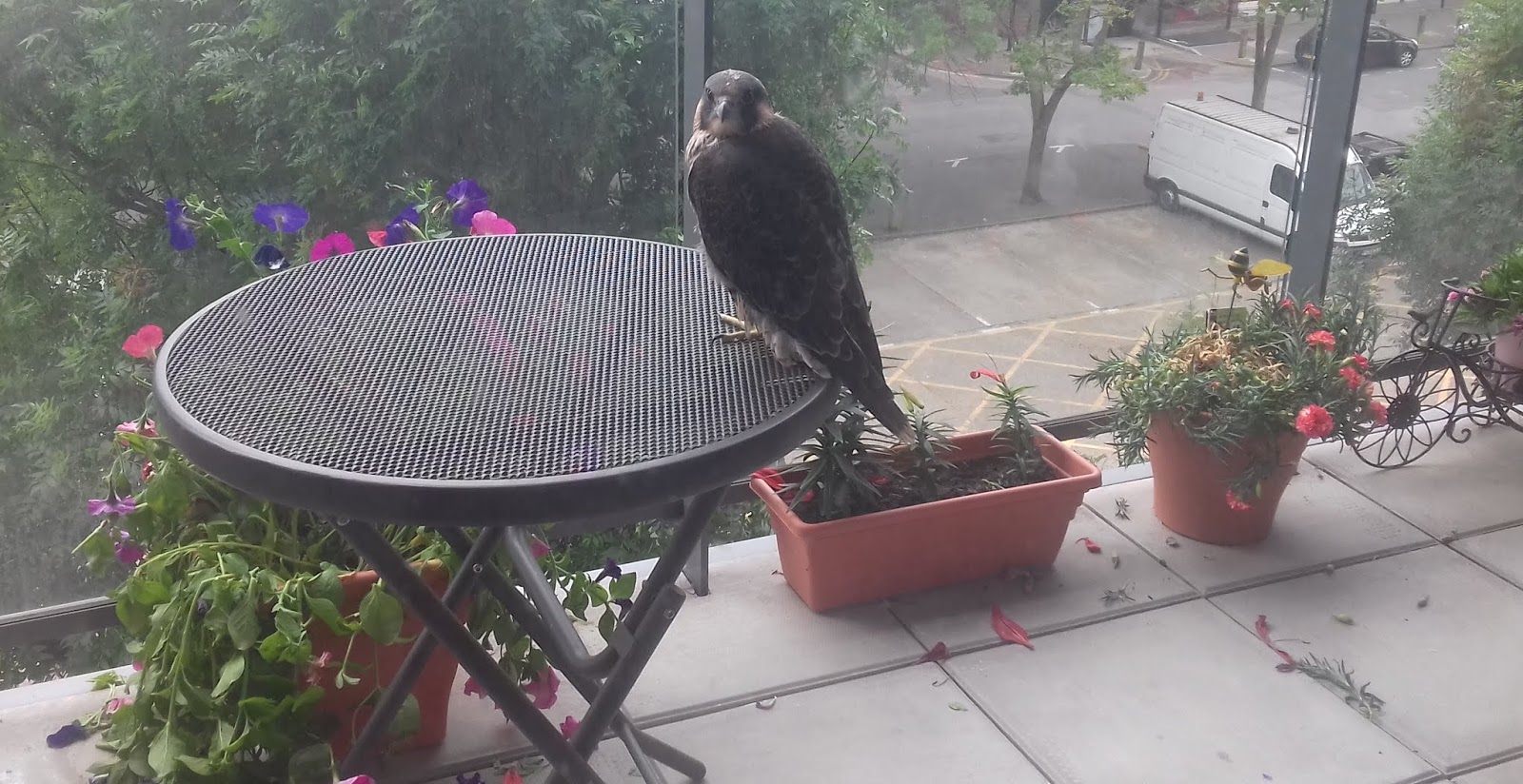
To date 7 have come down on their maiden flights, an urban environment is a dangerous place with many pitfall’s to trap a juvenile, glass see through balconies to name just one. I have rescued a good few over the years that just sit behind the glass, totally confused that they can see the outside world but can’t get through the glass. At this stage also, they lack the wing strength and vertical takeoff prowess to clear the balcony.

On the other side of the coin however without these, many would end up on the ground and likely prey for Foxes if late in the day, the biggest thing however is the public, they have been incredible.

I retrieved a juvenile recently that had crash landed into a balcony late afternoon after being mobbed by 2 Crows low down.
It came to my attention the following morning after spending the night on the Balcony thankfully, the owners were marvellous.

The juvenile, in its attempt to escape, had trashed most of the flowers on the Balcony but all they could think about was the bird and its welfare, great people as are all that I meet when I retrieve a juvenile.


Behind glass, as you can see flowers had suffered

Sadly one juvenile was lost at a site after ditching in the Thames, it just makes you realise the water hazards that many coastal birds must face.


A very sad sight, the one that unfortunately did not make it


Hats off though to the Public and Construction workers, many juveniles wouldn’t make it without there help.


Released back successfully, the adults saw it straight away


Friday, 1 June 2018

Beckton update


May


I have visited the site a number of times in May, remarkably the Common Buzzard is still on site despite the attentions of the local Corvids and large Gulls, both are breeding locally so as you can imagine they get quite upset at its appearance.


Jay's are ignored basically

Herring Gulls are another matter

Whilst watching the Buzzard on a couple of occasions, I saw a male Sparrowhawk come out of nowhere and mob the Buzzard, both scenario’s it happened in the same area. I know there is an old nest there as I marked in the winter, sure enough looking through Bin’s, the tell tale sign was there with a female Sparrowhawk tail protruding.

Along with the Kestrels, will be good watching their progress.

The Kestrels are now taking prey into the box so eggs have hatched and young are present, as yet I have not had a visual with the chicks, likely next week, I am also hoping that fledging will take place without a hitch.
We positioned the box so that the young can access a large roof, hopefully it will give them more room to build wing strength and be better prepared for that all important 1st flight.


Plenty of food now going into the box with a Field Mouse seen on Sunday, additionally Lizards are featuring as per last year, they are very efficient little hunters.

Top marks also for Thames Water, setting aside large Wildlife Areas, not cutting and leaving to establish and grow wild, already invertebrates are colonising.


Female Black Tailed Skimmer

Needs no intro

Hairy Dragonflies

Mistle Thrush - now a Red List species


Wednesday, 9 May 2018

Hybrid or Arctic Peregrine?


Last year, courtesy of other birders who contacted me, I was told about a Falcon who was holding to territory in London, at the time there was also a Tiercel with her.
After watching behaviour in 2017, there was no copulation and no breeding activity shown last year at all, after a while the Tiercel moved on it seems.


Hybrid or Arctic?

Ordinary Peregrine, admittedly a Tiercel and different posture

As soon as it was practical, I visited the roof to check if there was the possibility of them breeding and also came across lots of prey remains as you would expect. 
What surprised me last year was the number of Gulls on the roof, predominately Black Headed but also a few Commons in the mix.

Pigeons were present but it was on a par with the Gulls, in prey collections that I undertake the odd Black Headed is present but pigeons have always formed the majority of the prey.


Gull prey was very evident

Woodcock

At the time looking at the Falcon, I thought she may have the look of a Hybrid; I got a few photos of her and kept an eye on her throughout the year. 
I visited the site the other day, she, as far as I am aware she is still on her own although a Tiercel has been seen occasionally.
On this visit, again she is non breeding and summering, the number of Black Headed and Common Gulls outweighed pigeon prey; it seems her preference is Gulls.

Additionally 2 Lapwing and Woodcock were also present.


Normal Peregrine

My line of thought now, having looked at her plumage and the fact that she may possibly have developed a taste for Gulls at her natal site – possibly the Tundra where Gulls are the dominant prey species. 
It’s hard to imagine an Arctic Peregrine in London but the plumage in some areas does fit, she’s not the normal Falcon plumage and she is also quite large.

She has also been in this plumage for 2 years so not about to moult either from juvenile plumage.

Comparing 


Additionally she could be a Hybrid, possibly unable to breed which might explain the Tiercel’s coming and going and not bonding. 

An interesting bird.

Saturday, 28 April 2018

Cooling Marshes


I have had the chance again recently to visit the Marshes, without doubt one of my favourite places having been involved in its transformation right from the start.


Visits of late have produced good migrants, although there has been a distinct lack of Wheatears, this place is usually a Wheatear magnet.
Without doubt it is the most flooded I have seen it in a number of years, however it bodes well for breeding waders, large floods for a food source that will take a while to dry up.

On my last visit, plenty of Yellow and White Wagtails seen working the area along with a distant clucking Ring Ouzel.


Perhaps the oddest record was a flyover Hawfinch, no doubt part of the national influx, can only presume it was looking for pastures new, hopefully some will stay and breed.

A massive flock of summer plumed Black Tailed Godwits was seen coming from the direction of Northward Hill, they headed straight over to Coryton, Essex presumably to roost at Holehaven Creek.


Black Tailed Godwit

I am out there again this weekend, hopefully more of the same.