Click on photos to enlarge, please do not copy photos without permission

Monday, 30 June 2014

Juvenile Cuckoo


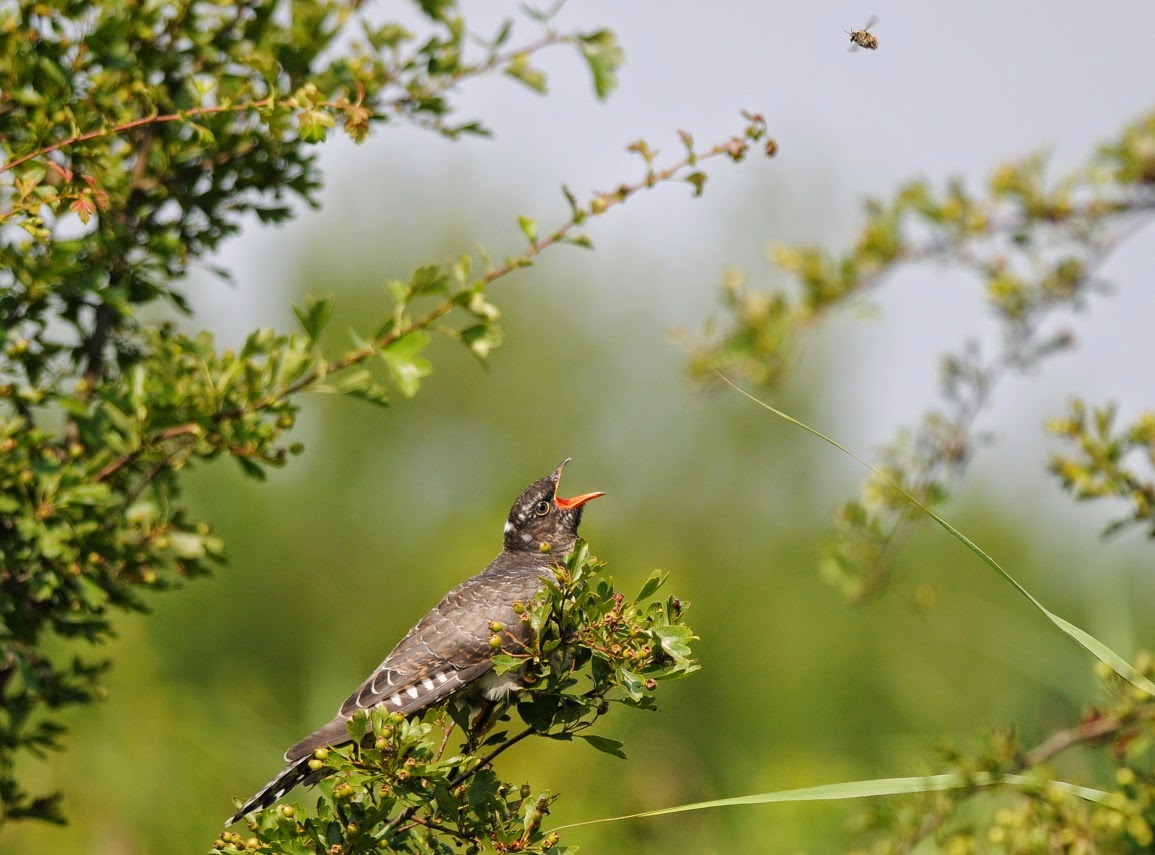
I came across this juvenile Cuckoo quite recently at Cliffe RSPB whilst looking for the Stilts, its not that often that you see a juv let alone get pretty close to it.


Eyeing the Fly


Whilst waiting for the adults to feed it, which were Reed Warblers from the brief glimpse I got of them, it was quite obvious that it had a voracious appetite.


Food


Any passing insect, including the Bee above was viewed with relish, I suspect that both adults, given its size, had a hard job satisfying its hunger,calling was constant.

Saturday, 28 June 2014

Cliffe RSPB


June 24th


With another spare day I thought I would have a crack at the Black Winged Stilts that bred at Cliffe, although recent news has been pretty negative.
Forever the optimist I thought that if I did a full circuit, the circular walk going up to the sea wall, back down by the Black Barn, I must see one of them.

I had picked a glorious morning and even at a relatively early hour I was searching for Dragons and Butterflies, Comma’s and Ruddy Darters were seen along the path, however I was here for the Stilts so started to scan the islands.


As expected just by the noise alone Black Headed Gulls and there young were everywhere with a small colony of Common Terns, intermingled here and there were Avocets, no Stilts though.


Even walking on main path, Black Headed Gulls were diving


All the way to the Sea Wall I scanned every bit of perimeter vegetation, Redshank, heaps of Avocets, 6 Ringed Plover and 2 flyover Curlews were seen.
The regular Spoonbill was also seen roosting.

Arriving at the sea wall produced first 1 then 2 together Sandwich Terns flying onto the Reserve; it was a rising tide so no doubt going to roost.

Sandwich Tern

Marbled White

Moving on and I came across the odd sight of a Tortoise sitting on the sea wall, first thought was how did it get up there?
Unfortunately someone must have placed it there as I realised that it was dead. Riddled with insects you wonder at how it got out here and the story behind it, unusual.

Unfortunately dead


Moving on , by now I had picked up around 20 Marbled Whites along the Sea Wall along with Small, Essex and Large Skipper seen also, Ruddy Darters were everywhere, scanning again produced no Stilts.

I then headed down the path towards the Black Barn, Emerald Damselflies were seen, still not sure which one but presume normal Emerald rather than Scarce, any help appreciated on the photos, how do you split them?


Normal Emeralds or Scarce?


By the time I had arrived at the first mound, I had picked up 3 singing Corn Buntings, 1 along the sea wall with 2 along the straight path.

Plenty of birds were seen searching for the Stilts but there is so much vegetation present they could easily be tucked away somewhere out of the way, still I would have expected to have seen an adult bird.

Moving on and I scanned from the 2nd mound, again negative but the pools were absolutely teeming with wildfowl, Pochard and Tuftie broods quite numerous, also the Black Swan, I suspect this is the same bird that we saw on our winter surveys on Hoo.
At the last Pool I scanned the back of the islands, again negative but did pick up a roosting Whimbrel amongst the Lapwings.

Avocet coming off the Thames to roost


A very enjoyable visit and I met a few Birders along the way, opinion seems to be divided on the Stilts, some are saying predated and others still here but in deep cover.

Hopefully it is the latter.

Saturday, 21 June 2014

Short Toed Eagle


During the week I at last got the chance to venture forth and undertake some Birding that is not Peregrine related, I am not complaining it’s just refreshing to have a change now and then.
With news circulating that the Short Toed Eagle was still present in Ashdown Forest I headed down that way early morning after getting precise directions from Bradders (Thanks).

Arriving at the Long Car Park I followed other Birders heading out along the path, great habitat soon produced Wood Lark, Tree Pipit and a family of Stonechats.
I also noticed that many had upped the pace and were striding out along the 800 metre walk( what did they know?) so I tucked in behind them for less wind resistance and matched them all the way, Birders we met coming from the site confirmed not seen yet. The pace increased, I was in a good position in case I had to slipstream.

Arriving at the viewing site showed about 40 odd people looking with Shaun, Mart and Jono present as well, all 3 were twitching before work it seems, like I have said before they are a bit touched.

With the camera still in the bag I settled down with the boys and scanned around, 30 minutes later a shout went up from behind us and there it was coming across our line of view.

Complete panic ensued as we all went for cameras, basically I made a right cock up of it, wrong settings but can’t complain with the views I got through the Bins.
Closer than any of the views that I have had of them in Spain or Bulgaria, it was a stunning looking bird and the views shortly after, when it landed in a tree through the scope, were just as good, especially of the head.


Dodgy photos of it, they don't do it credit, it is a stunner.


The boys went shortly after and I stayed, the advantages of retirement kicking in, after this I had a wander round, it’s good to see birds like Tree Pipit and Wood Lark, just don’t get to see them enough, also forgot how musical Wood Lark song is.

Tree Pipit

Wood Lark

Looks like Shaun and Mart have found a mirror again and are checking there hair.

Eventually I headed back home after adding a couple of Common Buzzards and a Hobby, a thoroughly good morning and I suspect that if it stays, I may well head down there again for another crack at it.

Majestic.

Wednesday, 4 June 2014

Crows


As expected have been very busy of late in regard to London's Peregrines and have had little time to post let alone do some birding.

However I did come across the scene below albeit a bit distantly showing 5 Crows absolutely going at it hammer and tongs.
From what I could work out it was 2 pair having a territorial dispute and a single Crow probably hanging around to see what happened, even a Magpie joined in.

One of the pair was permanently pinned to the ground whilst it received a fearful bludgeoning from the other Crow pinning it down with the 2 mates having a scrap as well.
It could be also that the bird pinned down was sick and Crows being Crows had tried to finish it off, unfortunately I never saw the outcome.


Wednesday, 21 May 2014

Common Terns on the Thames


As some may know I am involved in the Thames, more specifically winter roosting waders and riverside structures/jetties along the Thames corridor, the aim is to try and get them recognised as a habitat. What initially started out within the London Natural History Boundary (20 mile radius from St.Pauls) 4 winters back may well now extend along its length as far as Southend.

For this I have to thank the London Wildlife Trust, Environment Agency, PLA and the Thames Estuary Partnership for pushing the idea forward, it is moving forward and the wheels are turning, not as fast as I would like but it is progressing.

I also have to thanks my mates for turning out in the depths of winter and doing a coordinated count of roosting birds at high tide.


Fords Dagenham roost with 300+ Black Tailed Godwits on board

Another aspect and spin off from this which was highlighted about 4 years ago is the use of redundant or even usedDolphin Jetties, they make brilliant Common Tern breeding platforms.


A Dolphin Jetty, this is the regular Common Tern breeding colony


For those that are not aware Dolphin Jetties are positioned at either end of the larger jetties, around 40 metres away, there sole use is to secure the ship at the Bow and Stern by large ropes anchored to the Dolphin Jetty.
They are anchored permanently to each particular Dolphin Jetty and when a ship arrives, the lengths of rope are still laying on the main Jetty to secure the ship.

Consequently this means that no one ever goes on each particular Dolphin Jetty, unless to replace a rope, this means that they are a haven for wildlife, in particular Common Terns and Oystercatchers.

A Dolphin Jetty is pretty largish, I would say around 10 times the size of a normal Tern Raft, due to this and the one I watch regular with 25+ pairs on it, the numbers makes for better defence from predation from Herrings, Lesser Black Backed and Great Black Backed Gulls. They simply cannot get near it, and I have seen this, they are attacked by 20+ Terns at the same time, it works and works well due to the size of the colony.

With Common Terns losing out to Black Headed Gulls on the larger Reservoirs, (Broadwater Lake for one) unused or even used Dolphin Jetties may well become an important resource – i.e. to safeguard numbers and large colonies in London.
Last year I blogged about a pair of Oystercatchers on the regular colony, by nesting with the Terns they automatically gain there protection, whether it was an intentional move is hard to say, the Terns gave them no trouble as there not seen as a threat.


The breeding colony of Common Terns


My idea with the number of Dolphin Jetties along the Thames is to utilise them for wildlife, it could be done at very little cost.

All you would need is an exterior haunch board, a covering of pea shingle and some pieces wood/logs to break it up into sections giving cover to chicks, if you want to go the whole hog, half moon salt glaze pipes here and there to give young cover also.


The colony on the centre jetty, the left hand jetty could soon be adapted to further increase the size of the colony.

The left hand jetty


Pretty soon a meeting will take place, hopefully a few pilot schemes like the empty jetty below can be put in place.


As above, ready to be used complete with waiting Common Tern

Saturday, 17 May 2014

Beckton Barn Owls


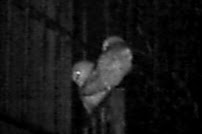
I have been aware of these, as have other London Birders probably for a good number of years, I can still remember Ken telling me about them many years ago, they have been on the Thames Water site for a good 25 years, very likely longer.

Being a Schedule 1 species I have never advertised them, not until now, they only really came visually to my notice with confirmed breeding in 2011/12, this was when I spent quite a bit of time watching them.

Being that it is now a very secure site, and in particular an impregnable nest site, I thought I would bring them to light having checked firstly with Thames Water.
Being involved with London’s Peregrines, advertising them is not something I would do lightly unless totally secure and on a private site.


As you can imagine they are very hard to see and totally nocturnal, I know they range along the A406 verges as I have seen them, they also cross the A13 as again, I and other Birders have seen them. These are total Urban Owls, they are extremely site faithful and even with a massive construction program they are still present, albeit nocturnally.

Having said all that, of late I have put in a bit of time in the dark hours lately and have not seen them coming or going to their nest site, if indeed they are nesting.

Are they still present, hard to say, could the dramatic changes to their foraging areas, large scale construction on site finally pushed them onto pastures new? A new landscape for wildlife is being put in situ along with a pond so given time wildlife will return, Boxes are also being put in place for them.


I intend to try and find out this weekend. Below are a few photos from the past few years, I hope I am wrong on this and am just missing them.


Friday, 9 May 2014

Wood Sandpiper at Hoo


Monday was to be a really good visit, they all are but this was too be made even better with the finding of a Wood Sandpiper and really good views of a hunting Hobby.

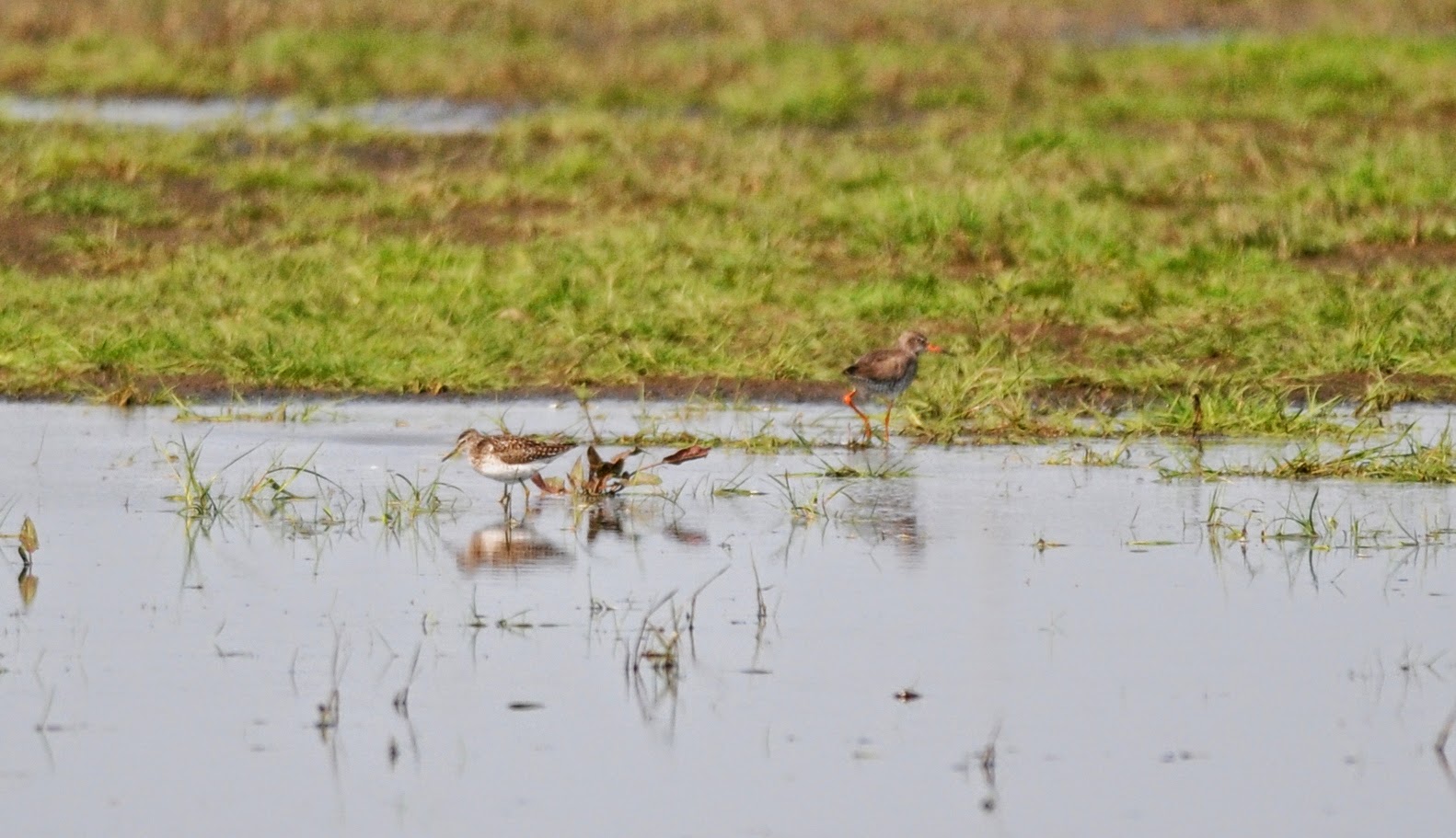
In truth the Wood Sandpiper was hard to miss, it was initially feeding with 2 Redshank, I was checking a Flood which the Shanks are showing a good interest in hopefully to breed. The bird was watched off and on for about 15 minutes before relocating briefly to another Flood and then heading off in a westerly direction. At the time I thought Cliffe RSPB would be a good candidate for another stop over but Paul picked up a Wood Sandpiper early evening at Rainham RSPB.
Given there’s not that many about at the moment it could possibly be the same bird.

Feeding with Redshank


Monday was also a good day for another wader, Whimbrel all 21 of them including a flock of 15, good to see, 6 Curlew were also present along with a single Ringed Plover.


2 late Wigeon were also picked up and at least 12 Gadwall have moved onto the Dykes/Fleets, some paired no doubt with the intention to breed in the area.
I also had stunning views of a low level Hobby, I was never going to nail it with the camera, just too close and too fast to get a lock on against the Fragmites. I watched it through Bins as it went away and it did actually take a Dragon, most likely a Hairy.


Wednesday was also a good wader morning with my usual check of Egypt Bay producing 19 Avocet, 14 Curlew, 12 Whimbrel and 3 Bar Tailed Godwits. With Oystercatcher and Common Sandpiper inland it made for a good selection.

Other inland highlights were 2 Wheatear, 2 Corn Buntings, Hobby, 4 Yellow Wagtails, Common Buzzard, 19 Swift moving through and at least double that amount of Swallows.


Corn Bunting brushing up


Interesting sight of the morning goes to a Marsh Harrier flying across a field and then suddenly plunging into the dense grass. Just before it entered the grass and only inches from the Harrier out came a Red Legged Partridge, a very lucky bird.
For myself I have never thought of Marsh Harriers regularly taking largish prey, usual prey at this time of year seems to be ducklings and land based adults/chicks of other smaller species. They are a large raptor and well equipped with those long legs in dropping onto larger prey so probably happens occasionally. I have heard about them dropping onto adult Coots at water fringes and drowning them but I suspect this is in hard winters and desperate for food?

To round off the morning a female Peregrine came in from the west, after monitoring them in London for the last 15 years, I still get the same old buzz whenever I see one; they to me are the perfect raptor.
I am biased but we all have our favourites don’t we?
Mind you I still have not seen a white phase Gyrfalcon……